.svg)
.svg)
In a split second, a pressure surge can burst a pipeline or bring a process to a grinding halt. So why are so many engineers still unsure how their relief valves will respond during hydraulic transients such as pump trips, rapid valve closure, and water hammer?
If a relief valve opens too slowly, closes too quickly, or isn't the right size, valuable equipment will be at risk of damage.
DATACOR Impulse software can help here. Steady-state hydraulic analysis alone cannot predict the transient pressure response of a piping system.
DATACOR Impulse enables detailed pressure-surge and water-hammer analyses, as well as transient flow modelling, under real operating conditions. In this way, you can simulate the hydraulic response of the piping system.
Accurate relief valve modelling helps engineers verify system designs and improve reliability. Therefore, it enables you to develop an appropriate pressure safety strategy. Most critically, it allows you to maintain control before a field failure occurs.
This guide provides an insight into the operating characteristics of relief valves in DATACOR Impulse. It further illustrates how individual parameters should be configured. Finally, you will gain an understanding of how simulation can support safe pipeline design.
A relief valve is a pressure-control device that opens automatically when system pressure exceeds a Set Pressure. Engineers use DATACOR Impulse to simulate relief valve performance during water-hammer events, pressure surges, and other transient conditions, evaluating system response before commissioning or operational changes.
All piping systems undergo pressure variations. Under steady-state operating conditions, these variations remain within the system design limits. During transient operating events, however, they may cause excessively high pressures.
The most common transient operating conditions that lead to excessive pressure rises include:
These events can cause severe hydraulic transients that subject equipment to significant stress. This may result in piping failure, equipment wear and tear, leaking seals, excessive vibration, and operational shutdowns. This will then lead to high-cost repairs or replacement.
Pressure safety in industry relies upon the effective function of relief valves. They are operated by system pressure. When the system pressure exceeds the valve's set pressure, the valve opens to release fluid and lower the pressure. Relief valves safeguard critical systems such as pumps, pipelines and processes.
In most industries, various surge-control devices are used. For instance, relief valves, surge tanks, and air chambers are often used in pumping facilities. Check valves and control valves are also used to regulate system transients.
Without a pressure surge analysis, engineers are in the dark about potential transient risks. That is a significant drawback, since steady-state calculations alone cannot identify transient problems.
Steady-state models are excellent tools to understand normal operation. They do not predict a system's behaviour during a transient state.
Engineers need transient hydraulic simulation software to evaluate system behaviour during changing operating conditions. These packages model time-dependent pressure and flow conditions, pressures, and equipment performance over time. This is where the role of the DATACOR Impulse model becomes evident.
DATACOR Impulse simulates water hammer, transient flow conditions, and hydraulic transients. It evaluates relief valve performance by modelling pressure wave propagation throughout the piping system.
Many engineering teams utilise a connected workflow utilising the following:
A common engineering workflow begins with steady-state hydraulic analysis in DATACOR Fathom, followed by transient surge analysis in DATACOR Impulse. The DATACOR Arrow is used for compressible gas flow systems. It enables a smooth workflow from the initial design phase to the final transient validation.
DATACOR Impulse allows engineers to evaluate several key performance characteristics, including:
Several operating regimes may be examined in DATACOR Impulse. As such, it will alert engineers to problems at an early stage, before construction, commissioning, or operational alterations.
The actual behaviour of a relief valve during a transient condition cannot be evaluated by hand with a normal calculation. The engineer needs to use simulation modelling to evaluate the relief valve's transient behaviour.
DATACOR Impulse simulates these conditions and determines how the relief valves behave during transient events. This will prevent excess surges, thereby increasing reliability and avoiding over-pressurisation failure.
Consider a pump station where a sudden power failure causes a rapid flow reversal. Without adequate surge protection, the resulting pressure wave may exceed the pipeline design pressure and threaten critical equipment. DATACOR Impulse allows engineers to simulate this scenario, evaluate relief valve performance, and verify that the system remains protected before the event occurs in the field.
It's also true that transient pressure surges occur very rapidly, within milliseconds. DATACOR Impulse can accurately capture rapid pressure transients and reveal the system behaviour during the transient. These data are extremely valuable in pressure relief valve analyses.
The relief valve has the greatest impact on system stability during a surge event. When valve performance is simulated, pipe stress, vibration, fatigue and unplanned shutdowns fall. The reliability of the system and its components will be greatly enhanced. In addition, the possibility of unforeseen downtime is lowered. This type of modelling ultimately increases system reliability.
Engineers may try different valve configurations and pressure settings. They may also be able to test different modes of operation. There will be no need to change the hardware when doing any of these simulations.
Teams can use simulation to tune:
Relief valves are seldom used in isolation. DATACOR Impulse facilitates an engineering analysis of interrelating equipment. It is a model showing the effect of relief valves operating with pumps, surge vessels, control valves and all other means of pressure control.
Engineers no longer need to rely solely on conservative assumptions when evaluating surge protection strategies. Simulation-based validation provides greater confidence in design decisions and system performance.
The DATACOR Impulse allows users to define valve profiles so that relief valves can be configured for the required system. The valve profiles supplied with the software, other than the universal custom valve profile, include: Rupture Disk, Pilot-Operated, Surge Anticipator, and Passive.
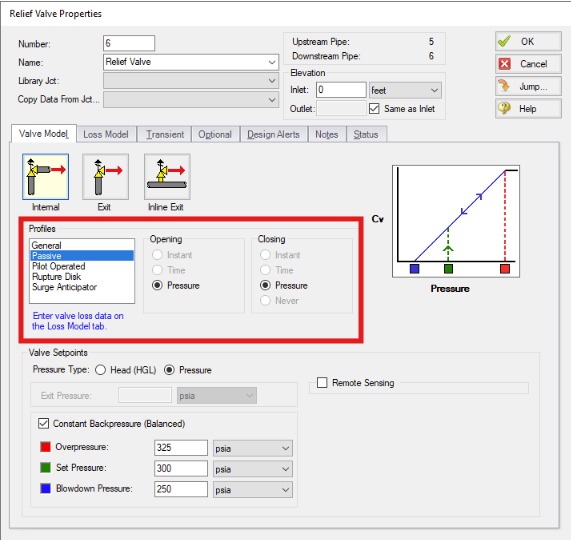
These valve profiles give engineers the flexibility to select the most appropriate protection strategy for a specific application and evaluate its performance through detailed transient simulations.
DATACOR Impulse provides several valve opening and closing methods that allow engineers to accurately represent relief valve behaviour during transient events. Selecting the correct operating method is essential for realistic surge analysis and pressure protection studies.
The granular level of setting makes it simple to meet manufacturer or project requirements. Engineers can tune the valve's operating behaviour to improve simulation accuracy.
DATACOR Impulse allows engineers to define relief valve operation using pressure-based and time-based parameters. These settings help represent real valve behaviour during transient events and improve simulation accuracy.
Set Pressure defines the pressure at which the relief valve begins responding to system conditions. Engineers can also define the Open Pressure characteristics to accurately model valve activation during pressure surge events.
Opening Time controls how quickly the valve moves from the closed position to the fully open position. Faster opening times generally provide quicker surge relief, while slower opening times may better represent actual valve performance.
Close Pressure and Closing Time determine when and how the valve returns to the closed position. These parameters are important because rapid valve closure can generate secondary pressure surges within the system.
Valve Position and Loss Coefficient influence discharge flow rates, pressure losses, and system recovery behaviour. Accurate configuration of these parameters improves the reliability of pressure relief valve analysis and surge mitigation studies.
With DATACOR Impulse, the engineer can model:
These features enable engineers to achieve a safer and more robust pressure protection scheme.
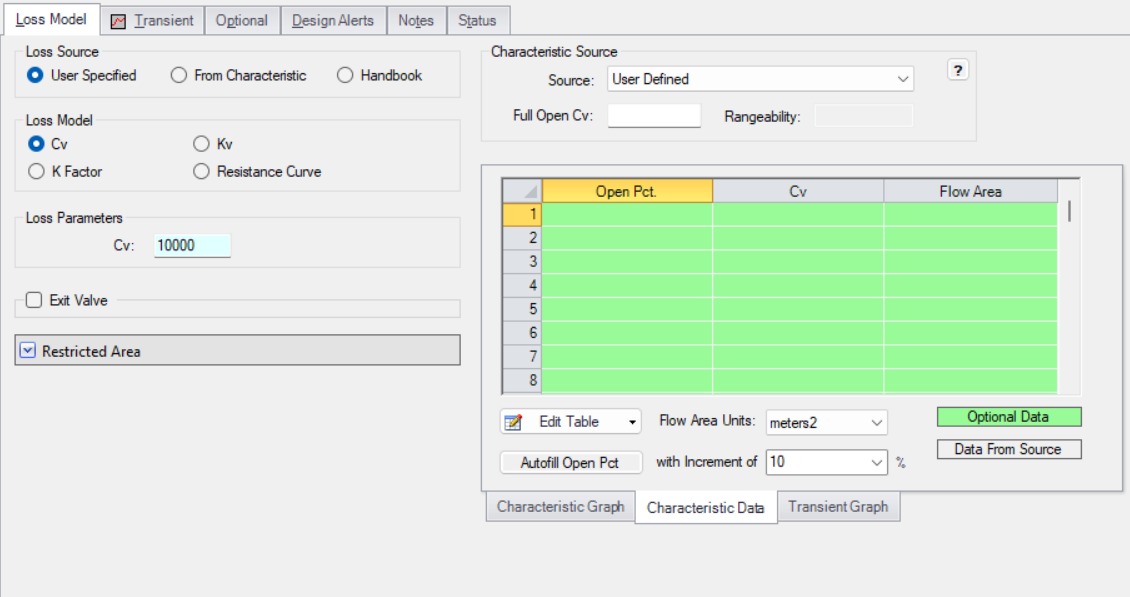
The valve loss coefficient is a major consideration in the analysis of pressure relief valves.
A valve loss coefficient is the resistance a valve offers to fluid flow. It is crucial in determining:
If it's not modelled accurately, simulation results might become irrelevant and poor decisions may be made. Using DATACOR Impulse, it is straightforward to model these effects during transient simulation. It will predict the relief valve's actual performance.
Strict control of valve losses is necessary when working at high pressure. Under these pressures, the smallest change in valve resistance is enormous relative to the overall final transient.
DATACOR Impulse integrates relief valve modelling and transient flow simulation. Therefore, it will secure the safety, stability and total protection of your system. The software allows engineers to evaluate real operating scenarios across multiple industries.
Commonly, municipal water hammer can be observed following a pump trip, a power loss, or a rapid valve closure.
Engineers can use DATACOR Impulse to establish the effectiveness of a relief valve. This allows engineers to design safe and efficient surge protection systems.
Conditions in a system can be quite severe and transient due to the scale and complexity of pipeline networks and process plants. You can perform specific relief valve simulations to protect:
Damage may occur to sensitive process equipment, and there may be a risk of a safety problem due to very high pressure spikes. Engineers may use DATACOR Impulse to verify that protection is adequate and to reduce risk.
The energy generation process demands resilient fluid-handling systems.
DATACOR Impulse may be applied for the transient analysis of:
An extremely long slurry pipeline is frequently used for mining. The great length would result in an enormous hydraulic transient phenomenon. Such systems can be protected against breakdown through simulation.
Data centres rely on uninterrupted cooling system performance. Relief valve analysis helps protect cooling loops from pressure surges that could damage critical infrastructure and impact uptime.
The engineering studies typically begin with steady-state hydraulic analysis in DATACOR Fathom, followed by transient event evaluation in DATACOR Impulse.
Using DATACOR Fathom, the user can:-
Upon performing a steady state analysis, the engineer can understand the response of a system to situations such as:-
In gas systems, DATACOR Arrow can handle complex compressible flow.
Both normal steady-state conditions and transient event simulations are therefore addressed.
The relief valve shall be designed in accordance with the codes and project specifications. Engineers shall consider:
The standard best practices include:
Under sizing a relief valve will result in inadequate relief during a surge event. An oversized valve could create system instability.
The design engineer should be aware of and carefully consider the pressures at which the valve will activate. It should protect equipment without opening unnecessarily.
The transient event should be considered not only in steady state but also under an actual event.
Relief valves are generally used in combination with:
The study of these components during the transient event should be part of a surge analysis.
Relief valves are essential for controlling pressure transients, such as water hammer. System overpressure should never be simply a matter of choosing the right valve.
The engineer needs a solid basic understanding of how a relief valve behaves within a system in operation. DATACOR Impulse achieves this through a comprehensive overpressure analysis. The engineer can verify the correct valve set point and the system's response before a problem develops.
Simulation applies to both new designs and upgrades of existing systems. The safety, integrity and operating performance of the system will be significantly improved.
Interested in increasing your transient flow analysis capabilities? Want to verify your pressure surge protection before commissioning?
Cortex Engineering Software can help you model relief valves, simulate water-hammer events, and optimise surge protection with DATACOR Impulse.
Our team can demonstrate DATACOR Impulse's powerful pressure control and valve selection.